Heavy Machinery Transport is rarely a simple matter of moving equipment from one address to another. Excavators, cranes, mining trucks, and industrial presses require careful planning, suitable lifting gear, and reliable route information. A machine may fit the trailer, yet fail at a low bridge, narrow gate, or weak loading surface. Small oversights can create expensive delays.
Chris Spear, President and CEO of the American Trucking Associations, has stated, “Trucking is the backbone of the American economy.” That principle is especially relevant to global machinery buyers. Transport connects factories, ports, construction sites, and final projects. However, international movement adds customs paperwork, port coordination, cargo insurance, and country-specific safety requirements. Every document matters.
This guide presents ten practical Heavy Machinery Transport tips for global buyers. It considers equipment measurements, weight distribution, loading methods, securing systems, route surveys, and delivery conditions. It also highlights communication between manufacturers, freight forwarders, carriers, and site managers. Clear photos help. Accurate drawings help more.
No checklist is flawless. Experienced teams still overlook an access road or misread a machine’s center of gravity. That is why planning should include independent checks, realistic timelines, and contingency options. Weather can change. Ports can congest. Local advice may challenge the original plan. That is not failure; it is useful information. Reliable transport decisions come from verifying details before the machinery leaves its first location.
Choosing the Right Transport Method for Heavy Machinery
Selecting transport for heavy machinery begins with dimensions, weight, center of gravity, and destination access. Ocean freight usually suits oversized excavators and industrial units. UNCTAD’s Review of Maritime Transport 2024 states that ships carry over 80% of global merchandise trade by volume. This makes sea transport practical, but port handling can add days and damage risks. Roll-on/roll-off service works well for mobile equipment. Flat-rack containers may suit machines that exceed standard container dimensions.
Air freight offers speed, yet its cost can rise sharply with dense, irregular cargo. It may fit urgent replacement components rather than complete machinery. Rail can provide a useful middle option across connected inland corridors. Road transport remains essential for the final delivery, especially when a crane or specialized trailer is required. Measure the route, not only the machine.
Details matter.
The World Bank’s Logistics Performance Index 2023, based on feedback from logistics professionals in 139 economies, highlights the importance of tracking, timely delivery, and reliable border processes. These factors should influence the transport method, not just the quoted price. A low ocean rate means little if the destination lacks suitable lifting equipment. I have seen plans fail because turning radius was ignored. That mistake is avoidable, but not always obvious from a spreadsheet. Confirm bridge limits, road permits, port handling capacity, weather exposure, and cargo insurance before booking. Build a contingency for delays. Perfect forecasts are rare.
Preparing Equipment, Documents, and Safety Checks Before Shipment
Tip: Inspect the machine before booking transport. Record its weight, dimensions, lifting points, center of gravity, and current condition. Photograph hydraulic lines, tires, attachments, and serial plates. Remove loose tools and drain fluids when required. A small measurement error can change the trailer, vessel space, or lifting method. The plan may still fail.
Tip: Prepare accurate commercial invoices, packing lists, certificates of origin, and transport instructions. Confirm the machine’s classification with a qualified customs specialist. The 2023 World Bank Logistics Performance Index covered 139 economies and highlighted reliability as a major logistics concern. Clear documents reduce avoidable delays. They do not replace professional review.
Tip: Build a route-specific safety file. Check bridge limits, road permits, port access, crane capacity, weather exposure, and cargo-securing requirements. UNCTAD reports that more than 80% of global merchandise trade by volume moves by sea. Therefore, inspect both inland transport and marine loading plans. Use certified lifting gear and verified tie-down points. Recheck tension after the first movement.
Ask for a pre-shipment inspection report. Include seal numbers, loading photographs, and emergency contacts. Keep digital and printed copies. Experienced teams sometimes overlook battery isolation or trapped pressure. That mistake is preventable. Leave space for correction, because real equipment rarely matches old drawings perfectly.
10 Heavy Machinery Transport Tips for Global Buyers
Planning Routes, Permits, and Cross-Border Customs Requirements
Global heavy machinery transport begins with a route that matches the cargo, not the map. Measure height, width, length, weight, axle loads, and center of gravity. Record every value twice. Mistakes happen. Compare bridge limits, turning radii, road grades, construction zones, ferry decks, and border operating hours. Ask carriers for recent route surveys, not old estimates. A 4.5-meter load may clear one road and stop beneath another overpass. Build a route with legal alternatives. Weather can close mountain crossings without warning.
Permit planning should start before booking equipment. Apply for oversize and overweight permits in each jurisdiction. Check escort vehicle rules, travel windows, pilot requirements, lighting, warning signs, and police coordination. Some permits follow the truck; others follow the exact route, axle arrangement, or shipment date. Keep certified drawings, registration papers, insurance evidence, packing lists, and load-securing plans accessible. Translate key documents when officials require it. Confirm whether permits must be printed. Digital copies alone may not satisfy a roadside inspection. Get written confirmation from authorities or qualified customs brokers.
Cross-border customs needs accurate tariff classification, declared value, origin, and ownership status. Used machinery may require serial numbers, inspection records, cleaning certificates, or temporary-import guarantees. Check export controls and destination safety rules before dispatch. Never assume neighboring countries use identical paperwork. Match invoice descriptions with the machine’s actual configuration. Customs delays often begin with vague wording. Leave buffer days at ports and borders. Track seals, photographs, and handover times. Recheck the plan 48 hours before departure. Even experienced teams miss changed holiday schedules or local permit conditions. That weakness deserves a documented review, not a quick guess.
| No. | Planning Dimension | Recommended Practice | Useful Data or Threshold | Documents and Actions |
|---|---|---|---|---|
| 1 | Confirm the Complete Cargo Profile | Measure the machine in its actual transport condition, including attachments, fluids, detachable parts, fuel level, lifting points, and center of gravity. | Record length, width, height, gross weight, axle loads, wheelbase, ground clearance, and turning radius. Use certified weight data where available. | Prepare a packing list, technical drawing, equipment photographs, serial number, operating manual, and a signed weight-and-dimension declaration. |
| 2 | Select the Correct Transport Mode | Compare flat-rack, roll-on/roll-off, breakbulk, heavy-haul trucking, rail, and multimodal options according to dimensions, weight, schedule, and destination infrastructure. | Containerized transport may be unsuitable when cargo exceeds the selected equipment's internal dimensions or safe payload. Confirm the carrier's published limits before booking. | Obtain written confirmation of allowable cargo dimensions, maximum payload, lashing points, loading method, port handling equipment, and free-time conditions. |
| 3 | Survey the Entire Route | Check the route from the loading point to the final site, not only the international port-to-port section. | Verify bridge capacity, road width, overhead clearance, sharp bends, gradients, tunnels, ferry restrictions, rail crossings, construction zones, and border operating hours. | Use current road authority information and, for abnormal loads, commission a physical route survey with swept-path and clearance checks. |
| 4 | Check Axle Loads and Structural Limits | Design the trailer configuration around legal axle-group limits and the weakest infrastructure on the selected route. | Legal axle and gross-weight limits differ by country, road class, axle spacing, and permit category. Never assume that a legal gross weight in one country applies across a border. | Request an axle-load diagram showing each axle group, load distribution, trailer tare weight, and proposed load position. Obtain engineering approval where required. |
| 5 | Apply for Oversize or Overweight Permits | Identify every jurisdiction requiring permits for width, height, length, gross weight, axle weight, or route restrictions. | Permit conditions may specify travel times, escort vehicles, warning signs, lighting, police coordination, speed limits, and approved roads. Requirements are jurisdiction-specific. | Submit applications early with cargo dimensions, axle layout, vehicle registration, insurance evidence, route map, and loading details. Allow additional time for revisions. |
| 6 | Classify the Goods Correctly | Determine the correct Harmonized System classification for the complete machine and separately shipped parts, attachments, or accessories. | The HS system uses a globally standardized six-digit structure, while many customs administrations add national subheadings beyond six digits. | Verify the tariff code with the importing customs authority or a qualified customs broker. Keep product specifications, technical literature, and classification rationale. |
| 7 | Prepare Cross-Border Customs Documents | Ensure that commercial, transport, origin, and technical documents contain matching descriptions, quantities, weights, values, and consignee details. | Core documents commonly include a commercial invoice, packing list, transport document, import declaration, and proof of origin when preferential treatment is claimed. | Check whether the destination requires certificates, conformity documents, temporary-import paperwork, licenses, or pre-arrival filing before dispatch. |
| 8 | Select the Appropriate Incoterms® Rule | Define who pays for transport, insurance, export clearance, import clearance, duties, unloading, and inland delivery. | Incoterms® rules allocate delivery tasks, costs, and risk between buyer and seller; they do not determine ownership, payment terms, or customs tariff classification. | Name the exact delivery point and version of the rule in the sales contract. Confirm that the responsible party can legally perform import formalities in the destination country. |
| 9 | Plan Cargo Safety and Lashing | Secure the equipment for sea, road, rail, and handling movements using methods appropriate for its weight, center of gravity, and movement forces. | Lashing design should consider acceleration forces, friction, blocking, tie-down angles, rated capacity, lifting points, and the applicable transport mode standards. | Create a lashing plan, inspect chains and binders, protect vulnerable components, isolate batteries or fluids where required, and photograph the loaded condition before departure. |
| 10 | Build Contingency into Time, Cost, and Insurance | Allow for permit changes, inspections, port congestion, weather, border queues, customs holds, transloading, storage, and equipment damage. | The final landed cost may include freight, handling, duties, taxes, permits, escorts, storage, demurrage, inspection fees, insurance, and inland delivery. | Obtain cargo insurance suitable for the agreed responsibility and transport mode. Establish escalation contacts, milestone tracking, document cut-off dates, and a delay-response plan. |
Note: Permit thresholds, axle limits, customs procedures, taxes, documentary requirements, and safety standards vary by country, route, cargo type, and transport mode. Confirm all requirements with the relevant road authority, customs administration, port, carrier, and licensed customs professional before shipment.
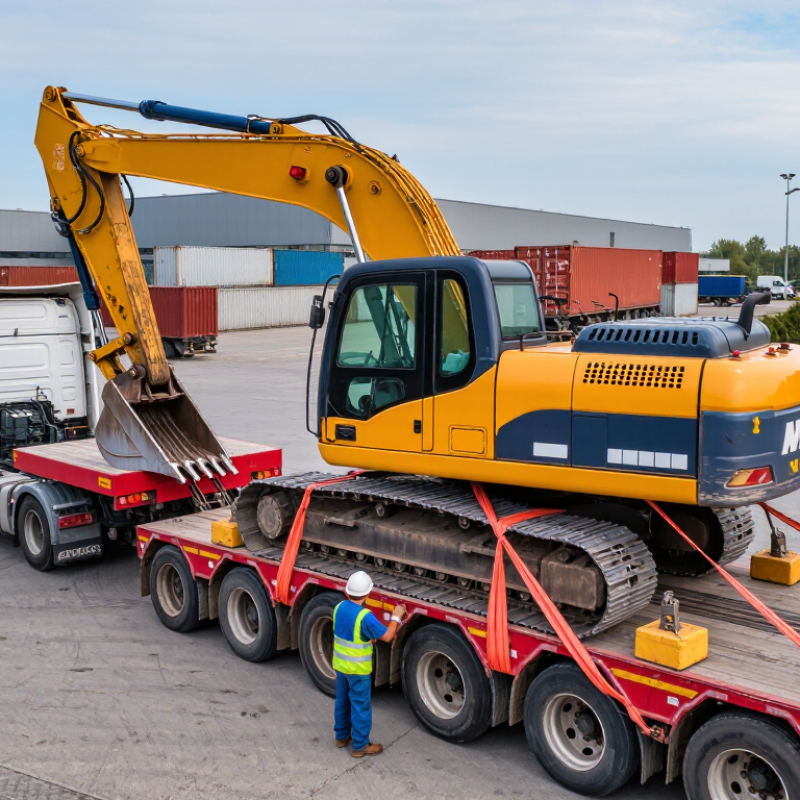
Heavy machinery arrives with its own transport risks. A 12-ton excavator can shift several centimeters when braking sharply. Before loading, record its verified weight, center of gravity, lifting points, and overall dimensions. Inspect tie-down eyes for cracks, corrosion, or deformation. Remove loose tools, detachable panels, and unsecured hydraulic attachments. Industry analysis cited by TT Club and ICHCA links approximately 65% of cargo damage to poor packing and securing. That figure deserves attention.
Use rated chains, webbing, edge protectors, and chocks suited to the machine’s weight. As a practical benchmark, U.S. FMCSA rules require aggregate tie-down working load limits of at least 50% of the cargo weight in many road movements. Local requirements may differ. Follow the IMO/ILO/UNECE CTU Code for container loading and restraint planning. Place hardwood or engineered dunnage beneath tracks and wheels. Friction is not enough. Photograph every connection before the vehicle leaves.
During transit, inspect restraints at planned stops, especially after the first 80 to 100 kilometers. Vibration can loosen fittings that looked secure at departure. Cover sensitive controls, but avoid trapping moisture around hot engines or electrical cabinets. At unloading, establish an exclusion zone and confirm ground stability before releasing restraints. A tilted machine can move unexpectedly. My field experience suggests that unloading receives less attention than loading, and that is a costly mistake. One overlooked hose or suspended attachment can change the entire risk profile.
Heavy machinery costs more than its invoice. A delayed crane can also stop a project, increase labor bills, and miss a seasonal delivery window.
UNCTAD’s Review of Maritime Transport 2024 states that maritime shipping carries over 80% of global merchandise trade by volume. That scale does not guarantee smooth handling. Request a door-to-door quote with lifting, port storage, customs brokerage, inland haulage, and possible demurrage listed separately. Some “low” quotes hide the expensive parts.
Tip 1: Insure the machine’s real exposure. Use a current valuation, inspection photos, and clear coverage for loading, transit, storage, and unloading. Allianz’s Safety and Shipping Review 2024 recorded 26 total losses of large vessels in 2023. The risk is uncommon, but the financial impact is serious.
Tip 2: Track milestones, not only location. Require updates for booking, port arrival, customs release, truck dispatch, and final delivery. The World Bank’s Logistics Performance Index 2023 highlights shipment visibility as a key logistics capability.
Tip 3: Build a delivery inspection into the contract. Photograph seals, tires, hydraulic lines, control panels, and serial numbers before signing. Record dents, leaks, missing tools, or moisture immediately. I would not rely on a clean delivery receipt alone. It proves receipt, not necessarily condition. Cost estimates can still be imperfect, especially when ports change schedules or inland access is restricted.